Eschewing the player-created character of its predecessor, the narrative here places you in the role of Asur, a humble farmer boy and aspiring Monster Tamer whose older brother, Dyeus, is renowned across Crown Nation for his skill as a master Tamer. Dyeus also has a bit of a rebellious streak, and his shenanigans put him at odds with the nefarious ruler Lord Taishakuten, who sends one of his fixers to kidnap Dyeus and make an example of him. Asur then sets out in pursuit of his lost brother, kicking off a journey of self-discovery and empowerment that will ultimately change the fate of the whole Crown Nation.
It’s an interesting plot setup that goes a bit beyond the 'I want to be the very best' plot that a certain other monster-catching series loves to adhere to, and I was shocked at how surprisingly dark it can get in certain places. The Holy Order certainly doesn’t mess around with its cruel governmental tactics, and the world of Crown Nation feels hostile and uncaring in ways that reminded me of my experience with some Shin Megami Tensei games.
Captured on Nintendo Switch (Handheld/Undocked) Couple this with the role-playing and branching narrative that works with the dialogue trees of NPCs, and you have a rich narrative with mature themes that can develop in some genuinely unexpected directions.
Gameplay follows the expected format of the monster-catching RPG, but with some nice quality-of-life features to smooth the experience. For one thing, there are no random encounters - monsters roam the map and will uniquely react to your presence depending on the disposition of the creature. So, predators will generally chase or stalk you, while the friendlier herbivores will either be unmoved by your presence or flee if you get too close.
Not only does this mean that combat encounters are something you have more control over engaging with, but it also interacts well with the bait system, in which you can put out bait to either distract creatures to sneak around them or to coax out a rather shy specimen you’re trying to nab.
Captured on Nintendo Switch (Docked) When you enter an encounter, things play out with a familiar rock-paper-scissors, turn-based combat system. Each monster has resistances and weaknesses to each of the five move types, and every creature has a set list of moves that it can make, each of which pulls from a pool of move points that limit how often they can be used. If one of your creatures goes down, or you have another in reserve that’s a better match for your current foe, you can swap in one of your other monsters to gain the upper hand.
So far, so similar, but things get a little more interesting with the inclusion of the Synergy bar. Every time your monster acts, it’ll fill up a varying number of percentage points in a global Synergy bar that all monsters can tap into. Once you’ve got a fair amount built up, you can then burn some of the bar to ‘Crown’ one of your moves, bolstering its effectiveness and sometimes adding some cool new passives that make it more potent.
I really enjoyed the risk/reward aspect; it’s a lot easier to burn Synergy than it is to build it up, and there’s a brilliant tension to determining when to crown a move and when to hold some in reserve to deal with whatever gets thrown at you later in a drawn-out fight.
Captured on Nintendo Switch (Handheld/Undocked) And of course, if you’re battling a wild monster, you can then decide to catch it by tossing a contract at it. If you do so right from the jump, most monsters won’t even bother to read it because you haven’t gained their respect yet. So, you’ll have to beat them within an inch of their life and perhaps inflict a status ailment or two, raising the odds of them accepting the terms and joining your team.
Like in all great monster catchers, there’s a delightful tension to that moment when you toss out a contract at a desirable creature and hold your breath as you wait for it to ponder its decision, not knowing if it’ll acquiesce and end the fight there or respond with a vicious attack.
Drawing a bit from some notable non-Nintendo monster catchers, there’s also a robust monster breeding and fusion system that proves to be impressively addictive. Not only can you get some brand-new creatures as the offspring of two distinct species, but you can really get into the weeds of editing the genes of your monsters to get just the right combination of stats, traits, and moves on the ultimate monster for a given role in your party.
Captured on Nintendo Switch (Handheld/Undocked) Much like in something like Dragon Quest Monsters or Shin Megami Tensei, it’s the sort of system that really starts to open up once you build up a good collection of fodder, and it can be a great 'puzzle' to plan out several generations of creatures as you slowly close in on the specific one you’re looking for. If you’re the kind of player who likes to tinker with party compositions and loadouts, you’ll really appreciate that there’s a lot to dive into here, yet it never feels overwhelming or needlessly abstract.
I was also impressed by the openness of the overall gameplay flow, taking the training wheels off after a relatively linear beginning and opening things up somewhat like the more recent Zelda games. Though you can’t beeline straight to the final boss, almost the whole map is opened to you after this point and you’re encouraged to make your own way through it as you identify which bosses you’d like to take down next and what regions you’d like to prioritise exploring. Along the way, there are all sorts of points of interest, new monsters, and rival tamers to challenge Asur’s resolve as he continues his quest and grows his power.
Captured on Nintendo Switch (Handheld/Undocked) That said, a notable downside of this open-ended structure is that it can sometimes feel a bit directionless. The more recent Pokémon games have taken some flak for being overly handholdy, but it feels like Sin Eater overcorrects a bit too far in not giving you enough guidance for what to do next. There were some points where I found myself floundering a bit, wondering where to go next. This is a more personal nitpick, and some players may prefer experiences more akin to the sometimes opaque RPGs of days past.
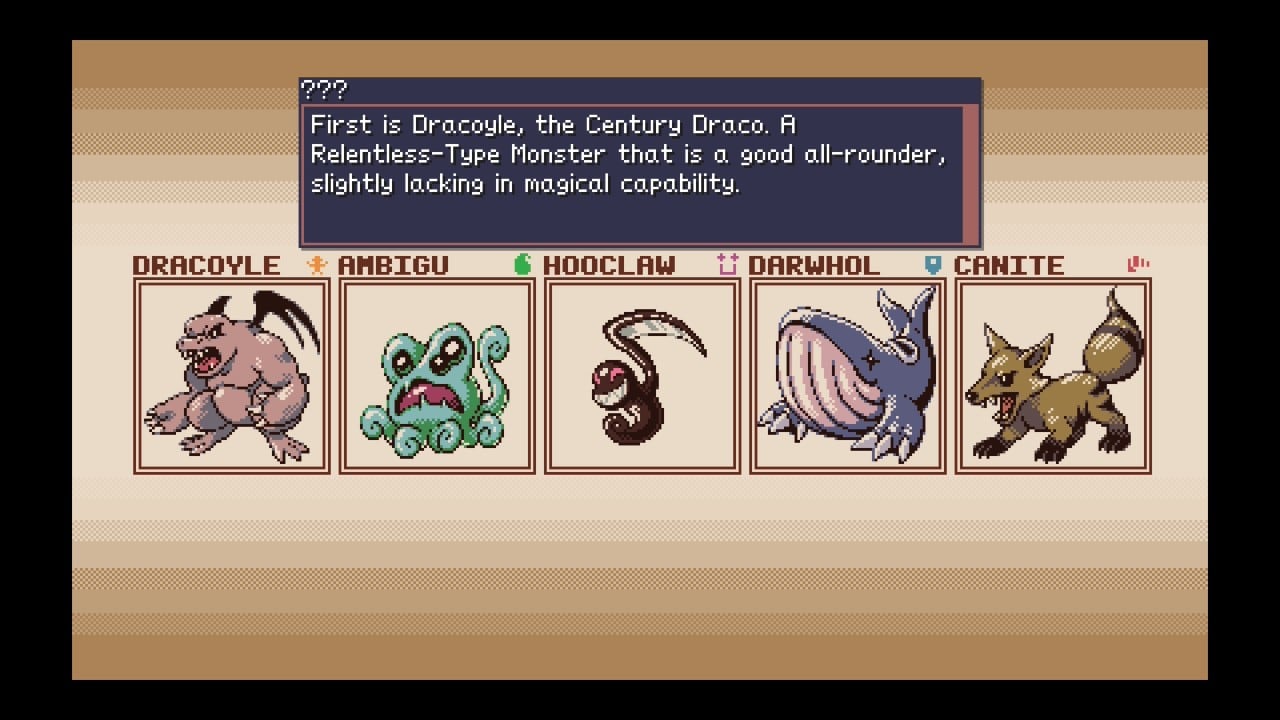
Visually, this adventure executes a brilliantly old-school 8-bit art style that faithfully calls back to the Game Boy Color Pokémon games, or even something more recent like the fan-made Pokémon Lazarus. The simple sprites are accented by some cleverly placed white lines that nicely contrast with the other colours, while things step up notably for the battle screens. Here, the pixel style gets noticeably more detailed with more advanced spritework, with move animations offering some show-stopping effects that really sell the monsters' fantastic, weighty attacks.
Captured on Nintendo Switch (Handheld/Undocked) This is all matched by an eccentric chiptune soundtrack that pulls from a variety of inspirations, perfectly enhancing the atmosphere with a variety of different moods and tempos. The energetic and whimsical main battle theme sounds like something Jake Kaufman would come up with for yet another Shovel Knight expansion, while some of the village and town themes sound like they’re from a lost PS1-era JRPG. Suffice to say, it’s a nicely well-rounded soundtrack, and it pairs well with the onscreen theatrics.
Conclusion
Much like the breeding and fusion system at the heart of its teambuilding, Monster Crown: Sin Eater is a satisfyingly iterative improvement over its predecessor, refining the systems and strengths it introduced while tossing the things that held it back from being great. Deep party customisation, a surprisingly in-depth story, beautiful GBC-esque visuals, and a killer soundtrack all combine to make this one worth a punt, even if some growing pains with the open-ended design can sometimes drag it down a bit.
I’d give this one a recommendation if you’re looking for something to ease your pain after the Pokémon Champions launch. Sin Eater was made with lots of love and hopefully will form the basis of more adventures in this fascinating world.
Tons of party customisation Gorgeous GBC-inspired visuals Excellent soundtrack Branching, player-driven story Open-ended design can sometimes feel a bit too hands-off
 review by