
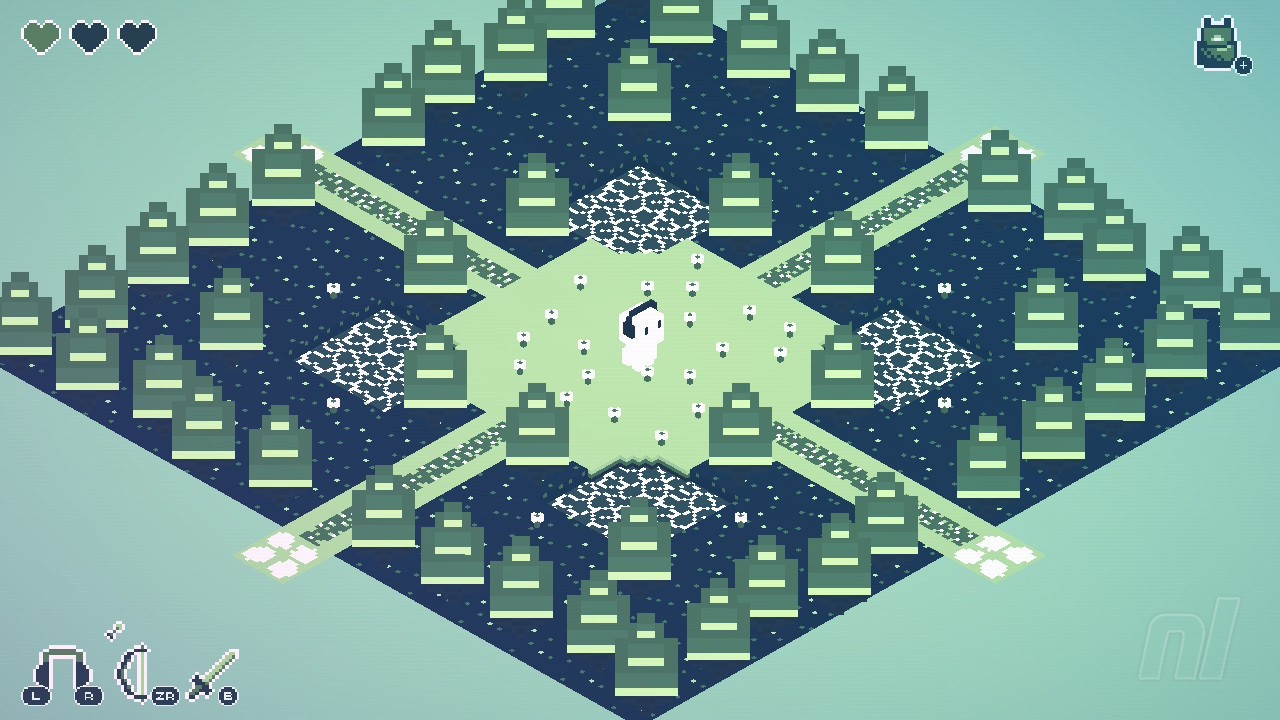
While it presents itself as a chilled-out ode to Legend of Zelda–style adventuring and the Game Boy aesthetic, Cassette Boy is more than meets the eye.
It opens with an ominous dream in which your protagonist is told, “If it can’t be seen, it does not exist.” From there, the game drops you into a very familiar scenario.
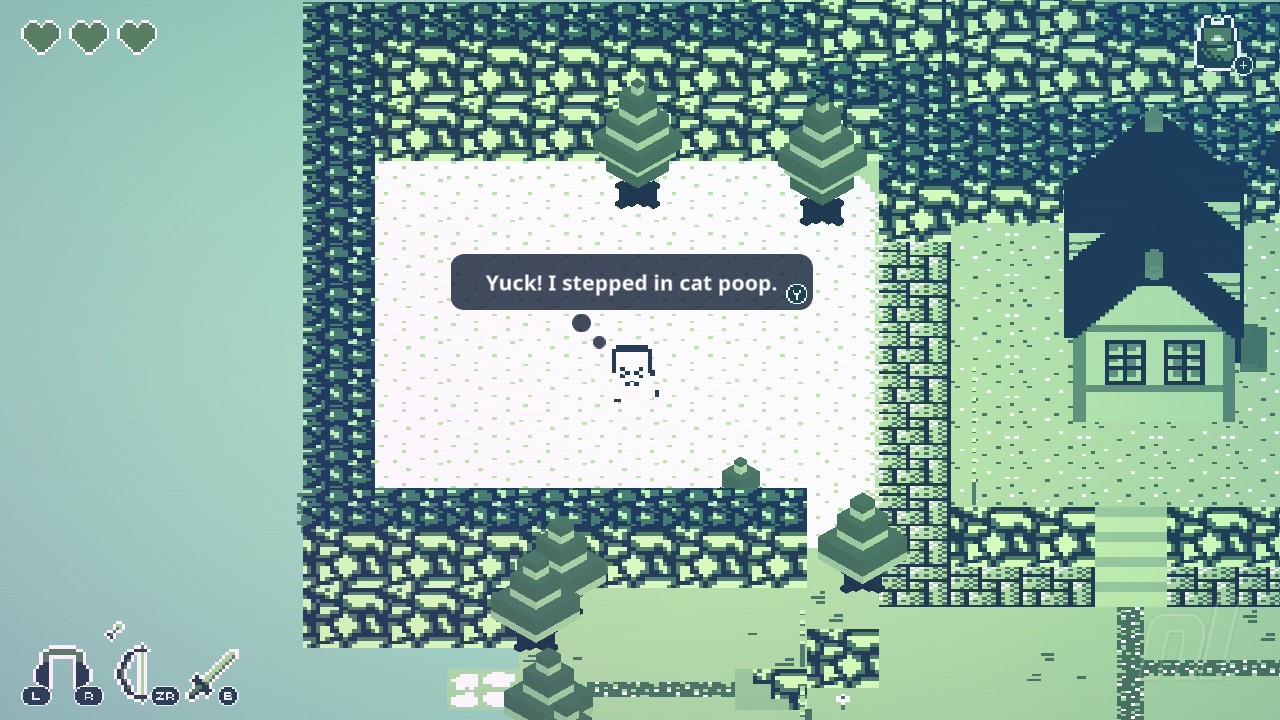
You wake up in your house, greet your mother, and step out into a small village that will feel instantly recognisable to anyone who has played Pokémon or any given Zelda title. It is so familiar, in fact, that you would be forgiven for rolling your eyes and dismissing Wonderland Kazakiri’s creation as just another homage to Nintendo classics.
That assumption does not last long. Your first dungeon (actually more of a basement) presents a progress block with a static, isometric corridor and a stubborn snail in the way. Instead of fighting it, you are instructed to flip the camera and make the snail stop existing altogether. A tap of the shoulder button and the whole world rotates on its axis, offering an entirely new viewpoint.
Cassette Boy is a game about perspective. The developers call it a "Schrödinger System". Traversal, combat, and puzzles all hinge on your ability to rotate the environment and cause objects, enemies, or hazards to cease to exist.
In that sense, it is like The Legend of Zelda, if Lizalfos were constantly at risk of their quantum superposition collapsing.
There’s another homage to note here. The dimensional shifting, paired with chilled-out chiptune beats, recalls Phil Fish’s classic, FEZ. That game offered an intoxicating world to explore with very little concern for traditional narrative structure. Cassette Boy leans more toward the generic side when it comes to its adventure.
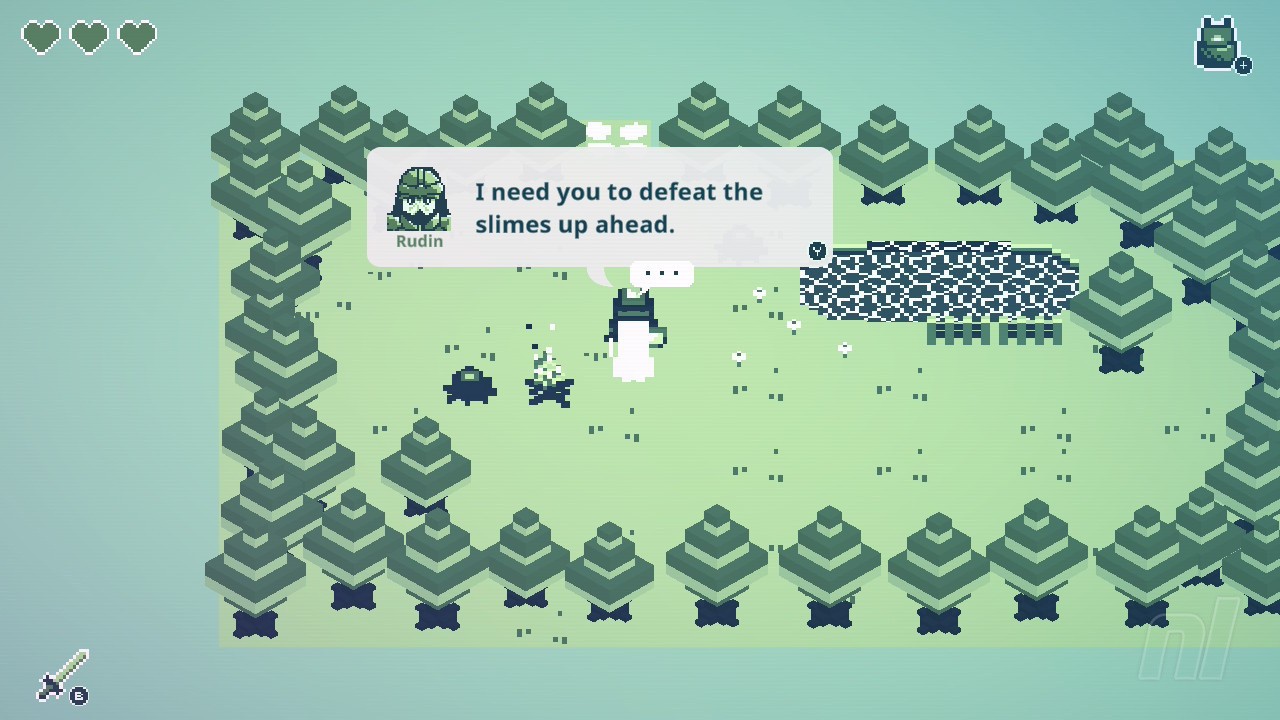
Setting out from the hub town, our hero collects weapons and power-ups, explores caves and dungeons, and hunts down fragments of the moon to reassemble it. There is nothing particularly exciting about the story being told here, and it rarely surprises.
The real hook lies in the often ingenious puzzle mechanics. Every enemy and environmental hazard is vulnerable to being obscured by camera rotation. Early on, this simply means erasing obstacles from your path. As the game progresses, however, you are required to make increasingly sharp logic leaps to move forward.
Switches stop functioning when they disappear. Deadly spike traps become harmless when obscured from view. Some devices in a room will only trigger after the camera has been rotated a specific number of times.
This can be deeply disorienting, especially during boss battles that are built entirely around this mechanic, but it is also where Cassette Boy is at its most clever and confident. After its initial tutorial quest and boss battle, the game stops holding your hand. Much like the titles that inspired it, you’re free to poke around the edges of a relatively open world.
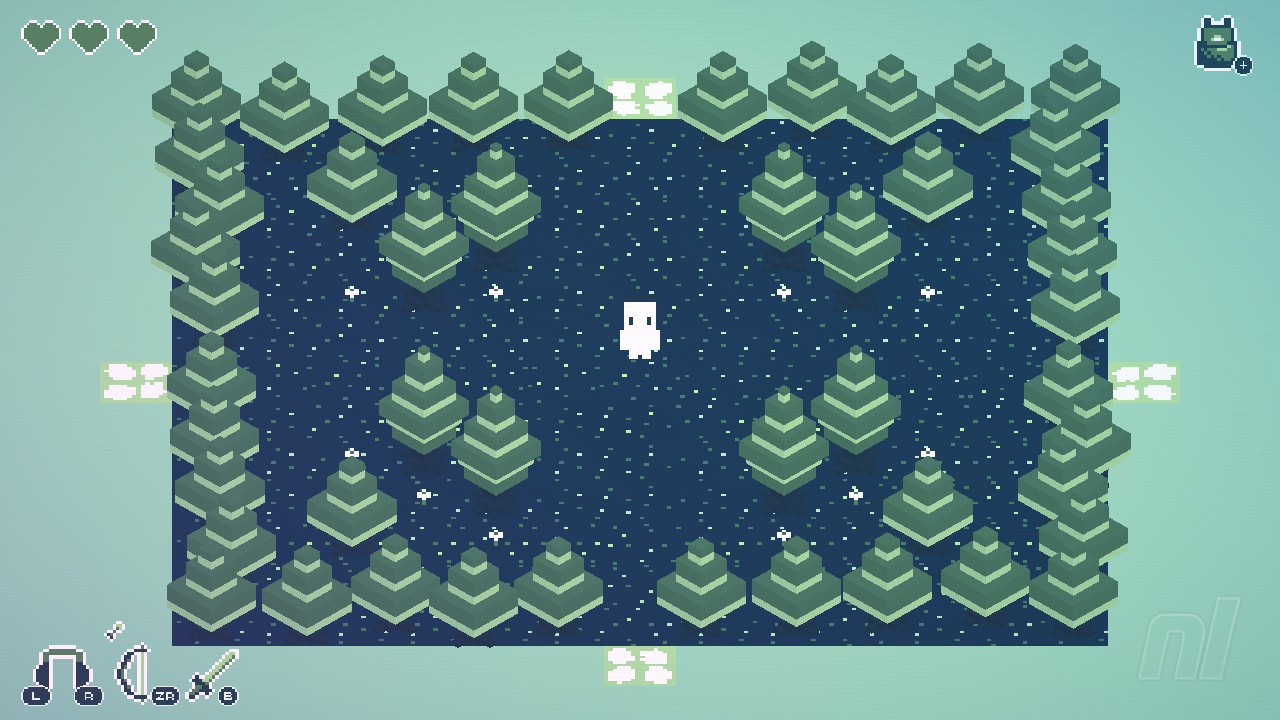
Progression is neither linear nor truly open, and it’s easy to get lost wondering where to go next, especially at the start, when you’re still acclimating to the shifting perspective. Luckily, any frustration is offset by the calming nature of green.
The game’s other creative flourish is the viridescent splendour of its Game Boy-like visual style. The initially harsh glow of the colour scheme gives way to a flood of childhood memories. It looks surprisingly sharp on a big screen, easier on the eye than you might expect. Rotating the camera from flat to blocky is fluid; it’s consistently satisfying to see those ancient handheld visuals shift into another dimension. Undocked is much more comfortable, though, if only because it feels like this style should always be depicted on a smaller display.
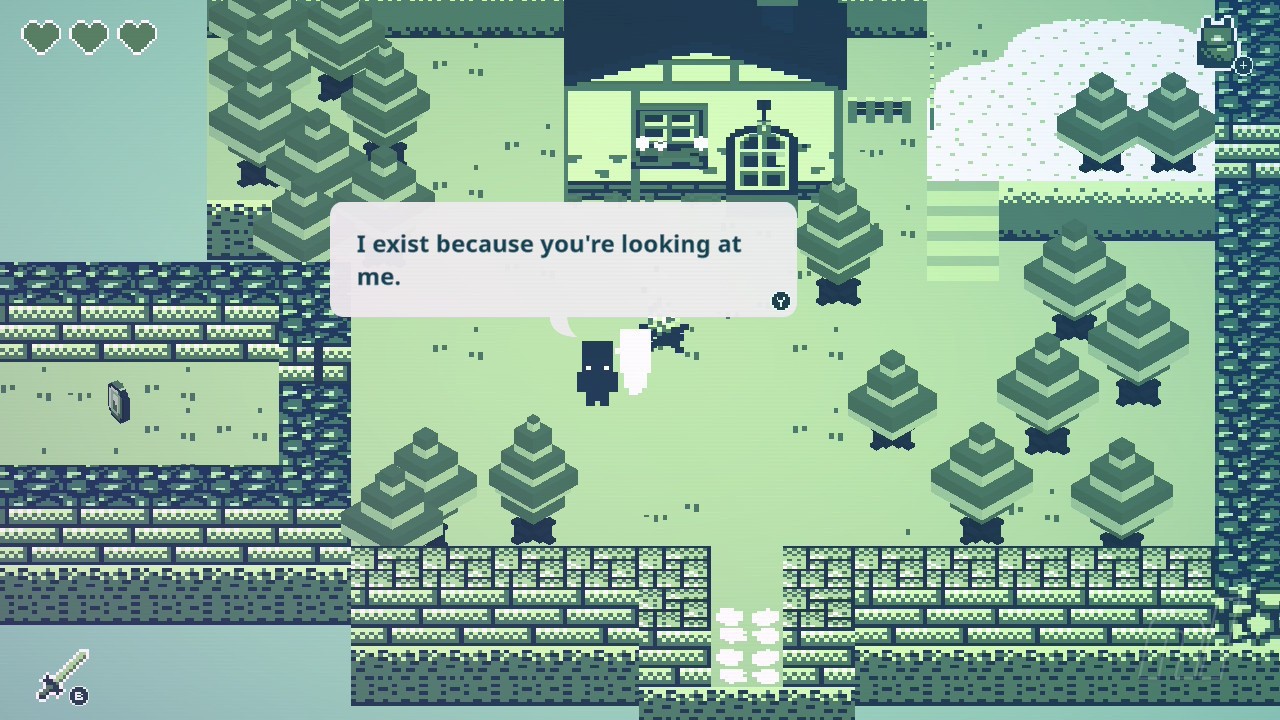
It’s a shame that the adventure itself isn't as compelling as the visuals and puzzling. Even with some snappy NPC dialogue, this is a journey you’ve taken countless times before.
While the roster of enemies is pleasingly odd at times, fighting them is pretty dull. Sword slashes and charged range shots are the order of the day for monsters that can't be sent into the void with a flip of the camera. There is a neat quirk with the ability set in which staggered tutorial prompts let you know of abilities you already had. This felt reminiscent of Tunic, a game that also wore its influences on its sleeve.
For all its shortcomings and liberal borrowing from better titles, though, it’s worth considering that, as a budget release asking a fraction of what others charge for similar — and often less innovative — experiences, Cassette Boy is still worth picking up.
Conclusion
A familiar adventure that pulls from the likes of Zelda and Pokémon for its setting and story, Cassette Boy is nevertheless a smart puzzler with a great visual style. The dimension-shifting mechanic never gets old, putting a fresh and literal spin on traditional isometric questing.


Comments 13
Thanks for the review, was already interested in Cassette Boy, but even more so after reading this (wouldn't have said no to an overall good game à la Zelda in general, but even more so one with such a literal and figurative twist) - looking forward to playing it myself when I can now that it's also on Switch!
Oh this does sound neat.
Lacks originality? That probably won't hold me off from playing the game at some point. It looks fun! And I like the aesthetic, too. Being an 80s kid.
The game mechanic oddly makes me think of Arranger...
I don't like the mix of 2D sprites with the 3D trees.
Looks cool, already on my wishlist!
Ingenious mechanic I've never seen in a game and yet also lacks originality? The pros/cons does not compute.
I dont know what cassette means in english, but in my language cassette is what i have between my balls LOL......cassette boy....man....is this game serious?
The gameboy look sucked when the gameboy was out, why do we have to keep having games like this. Atleast with pixels and sprites they can have a certain charm, this green on white only works for Spartans
This doesn't sound or look very fun. I'll pass.
This has more of an Atari look, then a Gameboy look.
@sketchturner
As mentioned in the review, the perspective shift mechanic which seems to be the cornerstone of this game lacks originality because it's borrowed from an earlier game called FEZ.
@Polvasti Rotating the camera is in tons of games (Mario 64, for example). It's utilized in a very different way in this game than Fez. In this game, rotating the camera makes it so that objects that can't be seen [due to camera perspective] no longer exist. I've beaten Fez, and it definitely did not do the same thing Cassette Boy does.
Show Comments
Leave A Comment
Hold on there, you need to login to post a comment...